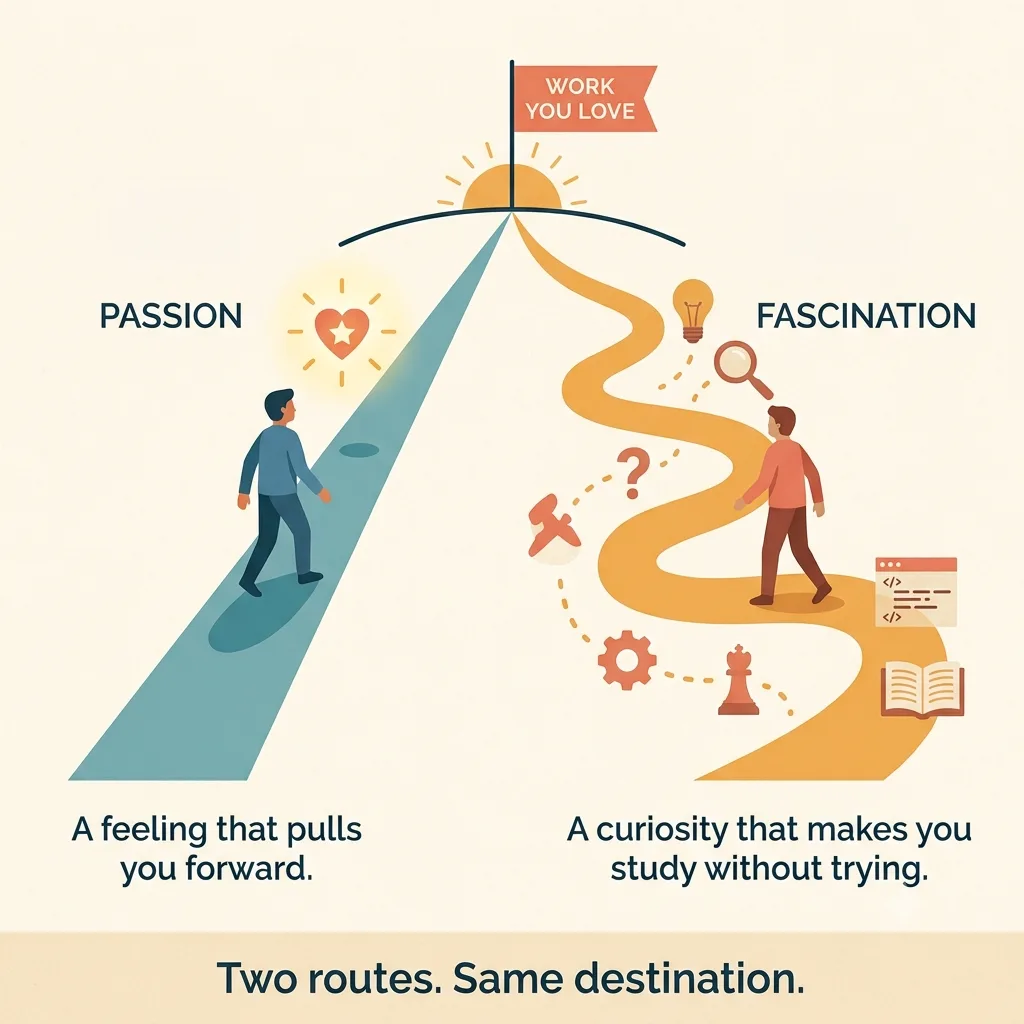
There's a particular kind of envy I feel around people who found their passion early and never let go. For everyone still waiting for that lightning to strike, I want to offer a second route to the same destination.
- Passion is a feeling; fascination is that feeling with an engine bolted on. When something fascinates you, you study it without deciding to.
- Fascination is often where passion comes from. You get curious, you poke at it, you get a little good — and the passion grows from there.
- The science backs it. Intrinsic motivation predicts better learning and wellbeing than any reward, and curiosity measurably improves memory.
- Stop asking "what's my passion?" Ask the easy question instead: what do I already lose afternoons to when nobody's paying me?
There's a particular kind of envy I feel around people who found their passion early and never let go. The friend who knew at fourteen she'd be a doctor and is now, twenty years later, exactly that and still thrilled about it. The musician who has practised every day since childhood and would do it for free. When passion like that takes hold, it's one of the best things a life can contain.
But I've also watched a lot of good people go quietly anxious waiting for that lightning to strike them, told over and over to "follow your passion" as if it were sitting somewhere obvious, waiting to be discovered. For them, and honestly for me, I want to offer a second route to the same destination. Not a replacement for passion. An alternative way in.
It's called fascination, and let me explain the difference with a story about my first computer.
I was eleven when my parents brought home an Amstrad CPC464. Green screen, a cassette deck built into the keyboard, a manual I couldn't read. I was gone within ten minutes. I'd copy programs out of magazines line by line, run them, and watch them break because I'd missed a colon somewhere on line 240. Then I'd spend an hour hunting for it. That hour never felt like work, and thirty years later I still can't switch the feeling off.
If you'd asked me what that was, I'd have said passion. These days I think fascination is the more honest word, and the distinction is interesting.
I owe the framing to two people who'd make an odd dinner party. Jerry Seinfeld, giving the 2024 commencement address at Duke, suggested that fascination might be the better thing to chase. The venture capitalist Bill Gurley liked the idea enough to build a whole TED talk around it. Neither of them, I should say, thinks passion is worthless. Nor do I. They're pointing at something subtler.
Passion is a feeling. Fascination has an engine.
Passion is a feeling, and feelings are wonderful. They're also, on their own, quiet. You can be passionate about your football team and express that passion by sitting in a chair for three hours with a beer. Nothing wrong with that. But the feeling, by itself, doesn't necessarily teach you anything or build anything.
Fascination is the same warmth with an engine bolted on. When something fascinates you, you study it without deciding to. You don't schedule the learning or push through it. You look up and the afternoon is gone. That's why I hunted for the missing colon at eleven, and it's why, as Gurley notes, the chess champion Magnus Carlsen once won a trivia contest on the history of chess. Nobody told Carlsen to study the history. The game gripped him, and the knowledge tagged along for free.
Here's the part I find reassuring rather than deflating: fascination is often where passion comes from in the first place. You don't usually arrive fully passionate about something. You get curious, you poke at it, you get a little good at it, and somewhere in there the passion grows. So if passion hasn't announced itself to you yet, fascination is a perfectly good place to start digging. It tends to lead to the very thing everyone told you to find.
The science under the nice phrase
And there's real science under this, which is what moved it from a nice phrase to something I'd actually bet on.
Psychologists call fascination by a duller name: intrinsic motivation, doing something for its own sake. Edward Deci and Richard Ryan have spent forty years showing that this kind of motivation predicts better learning, more creativity, and greater wellbeing than any reward you can wave in front of someone. There's even a trace of it in the brain. A 2014 study in Neuron found that curiosity measurably improves memory: when you're curious, the brain's reward system and its memory centre light up and start talking to each other, and you retain more, including things you weren't even trying to learn. "You study automagically" turns out to be a real event you can see on a scan.
This isn't passion's poor relation
None of which means passion is the poor relation here.
The psychologist Robert Vallerand draws a line worth knowing about. Harmonious passion is the healthy kind, the sort you've freely woven into your life and still control, and it's linked to genuine joy and balance. That kind of passion is absolutely a worthy goal, maybe the best one. The only version to be wary of is obsessive passion, the kind that controls you and crowds everything else out. So when I champion fascination, I'm not asking you to feel less. Harmonious passion and fascination are close cousins. If anything, fascination is one of the gentler roads toward the good kind of passion.
In 2018, researchers at Stanford and Yale ran five studies on what happens when people believe passions are simply discovered, fully formed. Those people tended to give up the moment a new interest got hard, because they expected the real thing to feel effortless. People who believed interests are developed kept going. The takeaway isn't that passion is a myth. It's that passion is usually grown, not found, and fascination is the soil you grow it in.
So what do you actually do with this?
Protect it and keep going
Wonderful. Feed it, build toward it. You don't need my advice; you need to keep going.
Ask the easy question
Stop asking the impossible one. "What's my passion?" has stumped people for centuries, and waiting for the answer can paralyse you. Ask instead: what do I already read about, watch, and lose afternoons to when nobody's paying me? That's fascination, waving at you. For me it was always computers. It was never a mystery — I'd just been calling it the wrong thing.
Weave it into your work
You may not land a job built entirely around what grips you, and that's fine. Be the person who actually understands how the thing works underneath. Take the projects that brush against your interest. Bring the knowledge nobody asked for. People notice that, and opportunity tends to find the obviously curious.
The honest bit
I'll finish with the honest bit the motivational version usually skips. Neither passion nor fascination guarantees a paycheque. Some interests have no market; some have a brutal one; sometimes life arrives with bills that don't care what lights you up. Gallup reckons only about a quarter of workers feel genuinely engaged, so most people aren't living either dream, and I won't pretend otherwise.
But chasing a passion is a worthy way to spend a life, and following a fascination is a worthy way too, and the lovely thing is they so often turn out to be the same path walked from different ends. One announces itself with a feeling. The other sneaks up on you through curiosity. Both can lead somewhere you're glad to have gone.
Mine started with a green screen and a missing colon when I was eleven, and it has never once felt like work. If you've already found your passion, hold onto it. If you haven't, follow what fascinates you. It's a fine way to get there.
References
- Jerry Seinfeld — 2024 Duke University commencement address — YouTube
- Bill Gurley — How to build a career you actually love — TED
- Ryan & Deci — Self-Determination Theory and intrinsic motivation (2000)
- States of curiosity modulate hippocampus-dependent learning — Neuron (2014)
- Robert Vallerand — The Dualistic Model of Passion
- Implicit theories of interest: finding your passion or developing it? — Psychological Science (2018)